
Co-op Water Damage: Decoding Master Policies vs. Individual Coverage
Why a co-op water leak can involve three insurance policies and a stack of governing documents.
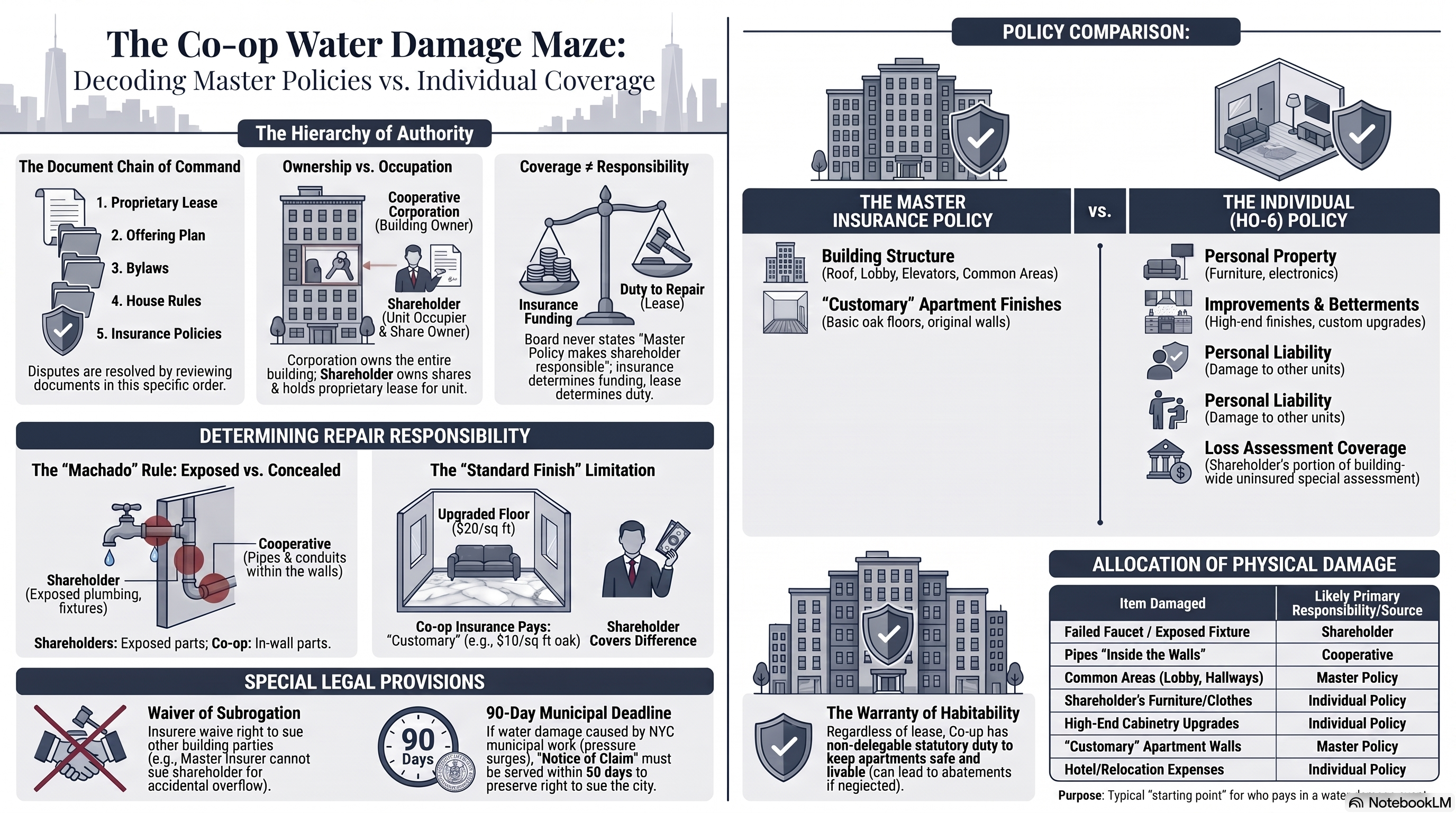
Water damage in a cooperative building is rarely straightforward. When a leak travels from one unit through walls and into common areas, three different insurance policies may come into play, and the documents that govern the building can be more important than the policies themselves.
The Hierarchy of Authority
When a dispute arises, the following documents are reviewed in this order:
- Proprietary Lease
- Offering Plan
- Bylaws
- House Rules
- Insurance Policies
The reason this matters: the cooperative corporation owns the building, while the shareholder owns shares and holds a proprietary lease for the unit. Insurance policies determine how damage is funded, but the lease and bylaws determine who has the duty to repair.
Master Policy vs. Individual HO-6 Policy
- Master Insurance Policy — covers building structure (roof, lobby, elevators, common areas) and "customary" apartment finishes such as basic oak floors and original walls.
- Individual HO-6 Policy — covers personal property, improvements and betterments (upgrades beyond standard finishes), personal liability, and loss assessment coverage.
Determining Repair Responsibility
The "Machado" rule is often used to allocate responsibility for plumbing:
- Shareholder: exposed plumbing and fixtures.
- Cooperative: pipes and conduits inside the walls.
The "standard finish" limitation means the master policy typically pays only the cost of a customary finish. If a shareholder upgraded to $20 per square foot flooring while the standard is $10 per square foot oak, the shareholder's individual policy may cover the difference.
Special Legal Provisions
- Waiver of Subrogation: insurers agree not to sue other building parties for accidental damage, which limits cross-claims after an overflow.
- 90-Day Municipal Deadline: if water damage was caused by municipal work (for example, pressure surges), a Notice of Claim must be served within 90 days to preserve the right to sue the city.
- Warranty of Habitability: regardless of the lease, the co-op has a non-delegable duty to keep apartments safe and livable, which can lead to rent abatements if neglected.
Allocation of Physical Damage
| Item Damaged | Likely Primary Responsibility |
|---|---|
| Failed faucet / exposed fixture | Shareholder |
| Pipes inside the walls | Cooperative |
| Common areas (lobby, hallways) | Master policy |
| Shareholder furniture / clothes | Individual policy |
| High-end cabinetry upgrades | Individual policy |
| "Customary" apartment walls | Master policy |
| Hotel / relocation expenses | Individual policy |
Co-op water claims are document-heavy and fact-specific. If your co-op or condominium is facing a disputed water loss, contact Digitory for help organizing the evidence, quantifying damaged contents, and preparing a defensible claim file.